Some details abstracted under NDA
Voice-First Thought Capture App
An AI-native in-house product I designed end-to-end from 0→1, built to make capturing and structuring ideas feel invisible. Currently in internal beta.
Year
2026
Role
Sole Product Designer
Stage
Internal beta
Platform
Mobile-first

THE PROBLEM
An idea lasts about 30 seconds.
Busy thinkers don't lose ideas because they're bad. They lose them because capturing them takes too long — and friction always beats a fleeting thought.
THE MOMENT
You leave a meeting with three clear follow-ups. By the time you find an app and start typing, two are gone.
→
ONEKEY
You talk. It transcribes, structures, and hands back a clean note — with the action items already pulled out.
For whom: executives, founders, creators — anyone who thinks faster than they can write.
DESIGN DECISIONS
Four decisions that shaped the product.
Each decision answers the same question: what does the user have to think about right now that we can remove?
01
Capture-first architecture
Open the app, you're already in the input. No menus, no "+" button, no navigation before capturing. Everything else comes after.
02
Quiet AI structuring
Categorisation and tagging happen in the background after capture. The user is never asked to organise — the AI's work shows up in the output, not during input.
03
One-screen review
All structured output in a single scroll. No folders, no hierarchy. Trust the model — but override anything in one tap.
04
Designed for trust
Every AI action is reversible. Users see what changed and can undo it without thinking. AI you can't undo, you stop trusting.
DESIGN SYSTEM
Built to scale, not just to ship.
No existing visual language meant building the system alongside the product. The goal: fast iteration without decisions breaking each other, and a developer who never has to ask "what colour is this?"
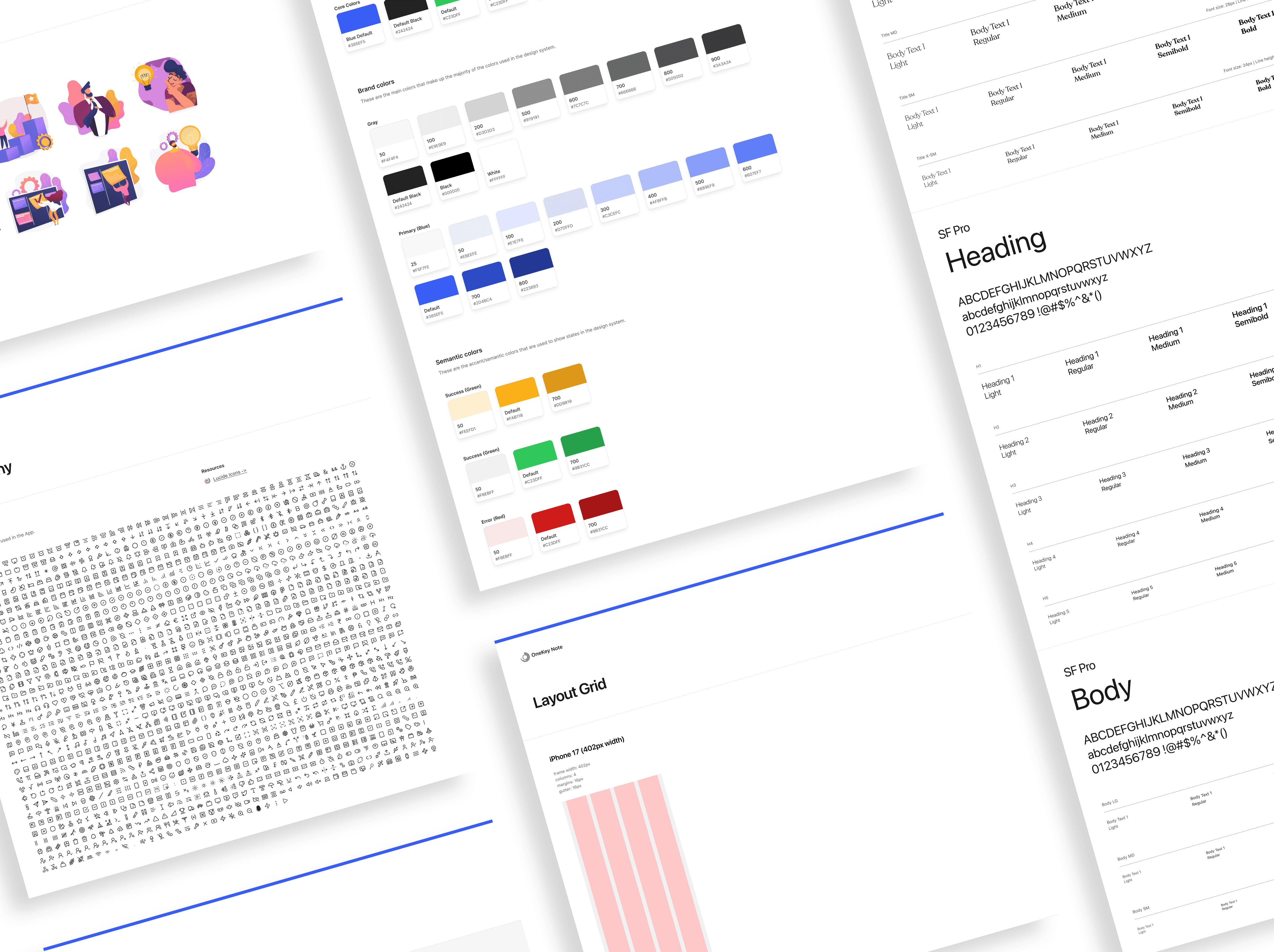
Design System
I created an maintained an exhaustive design system containing icon set, illustrations set, color system, typography system, layout, elevation, corners etc. along with do's and dont's.
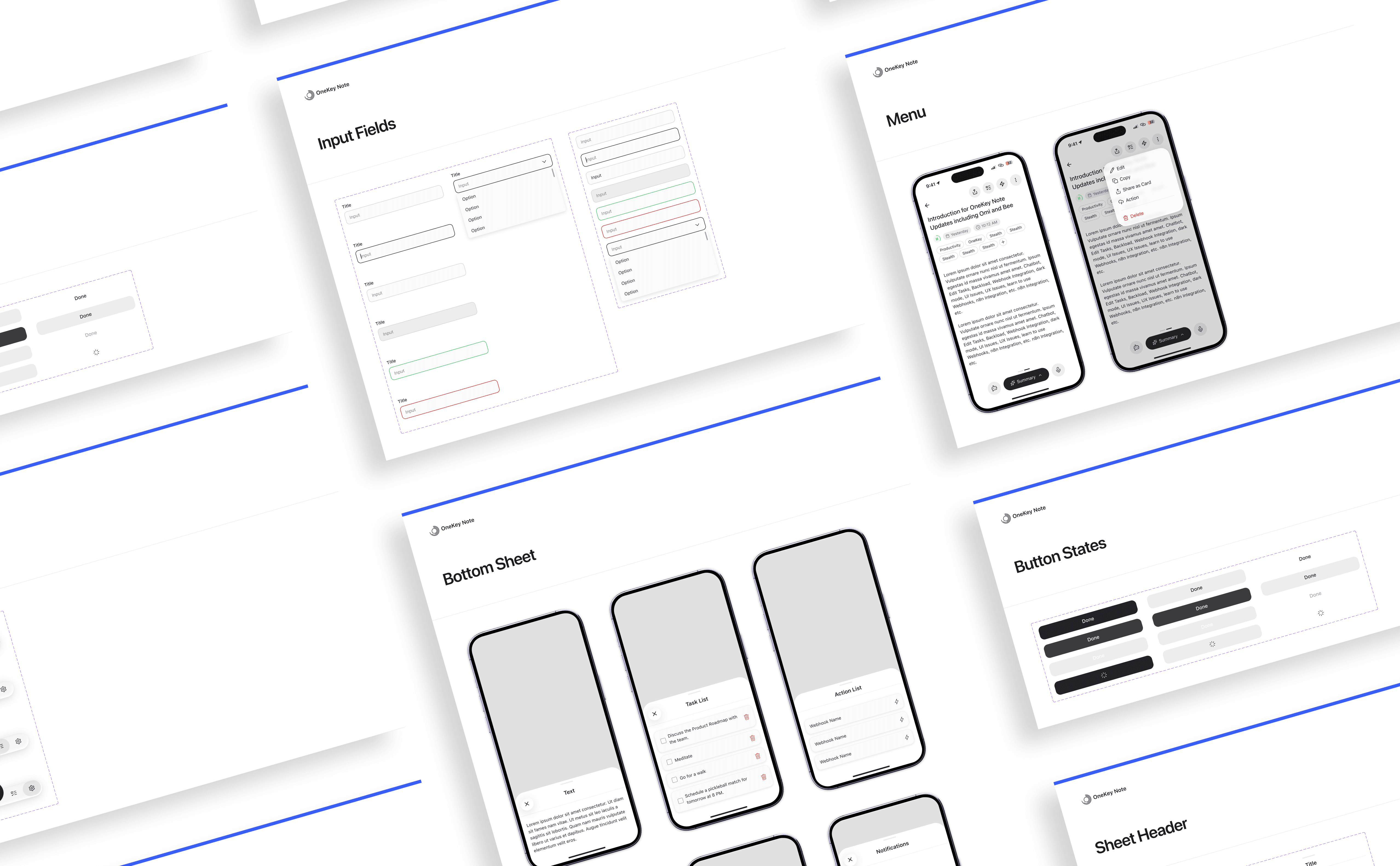
Component Library
Atomic level exhaustive component library consisting of elements like Button States, Input Fields States, Bottom Sheet Variations, Modal Popup, Menu Bars etc.
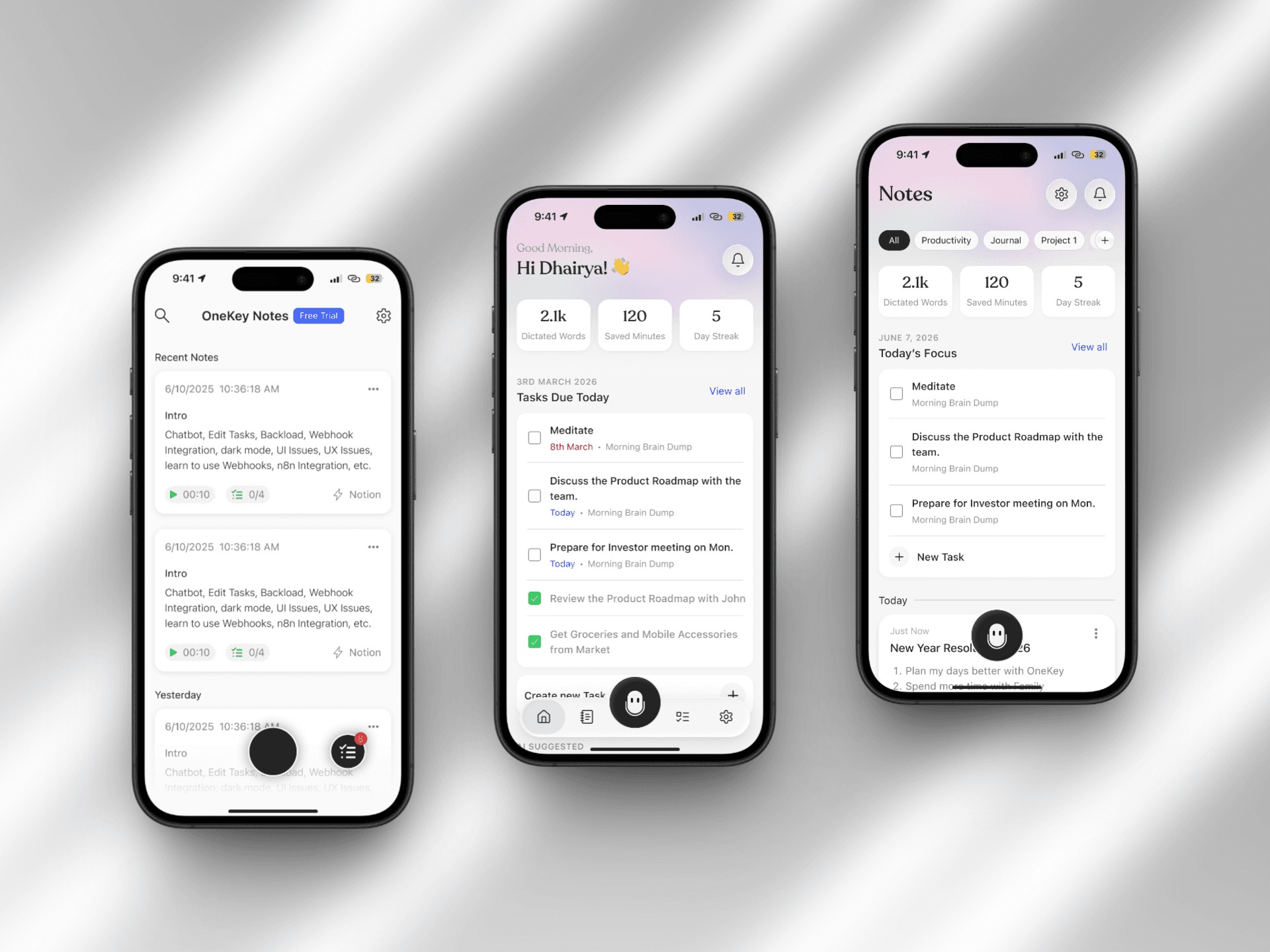
THE HOME SCREEN
I added structure to fix the home screen. The structure was the problem.
The hardest call on OneKey wasn't what to build. It was admitting a decision I'd shipped was making things worse — and undoing it.
1
The original
Flat note list, one mic button
Everything in one place. Simple, but it felt thin as the app grew.
2
The bet
As we grew, we added a nav bar
More features meant more to organise — so we split Notes and Tasks into their own pages. Structure felt like the responsible move.
3
The catch
Usage fell — ours included
Every extra page was one more decision before capturing a thought. People — us included — started tapping through the home on the way to record. The structure we added to help had become friction.
4
The fix
Removed the nav. Back to one screen.
The answer wasn't easier navigation — it was none. We returned to the single surface, but rebuilt it with sharper UX and a cleaner design system. Minimal in structure, far better in craft.
AI IN MY WORKFLOW
From idea to clickable in minutes - with AI as my team.
For this project, I worked alongside AI, to actually build in code and iterate faster, any new idea or direction that came up, I built it directly through Claude Code, tested it live and kept only what works.
01 • Branch
Spin up parallel branches to try competing directions at once — no "let me mock that up later."
02 • Build in code
Turn a direction into a working, clickable prototype in minutes — tested in the real environment, not a flat mockup.
03 • Pressure-test
Stress design decisions and edge cases, and draft and sharpen UX copy as I go.
04 • Ship the winner
Open PRs for what holds up. The rest get thrown away cheaply — fast to try, fast to kill.
The point isn't speed for its own sake. It's that I can test ten ideas in the time it used to take to mock up one — so the version that ships is the version that earned it.
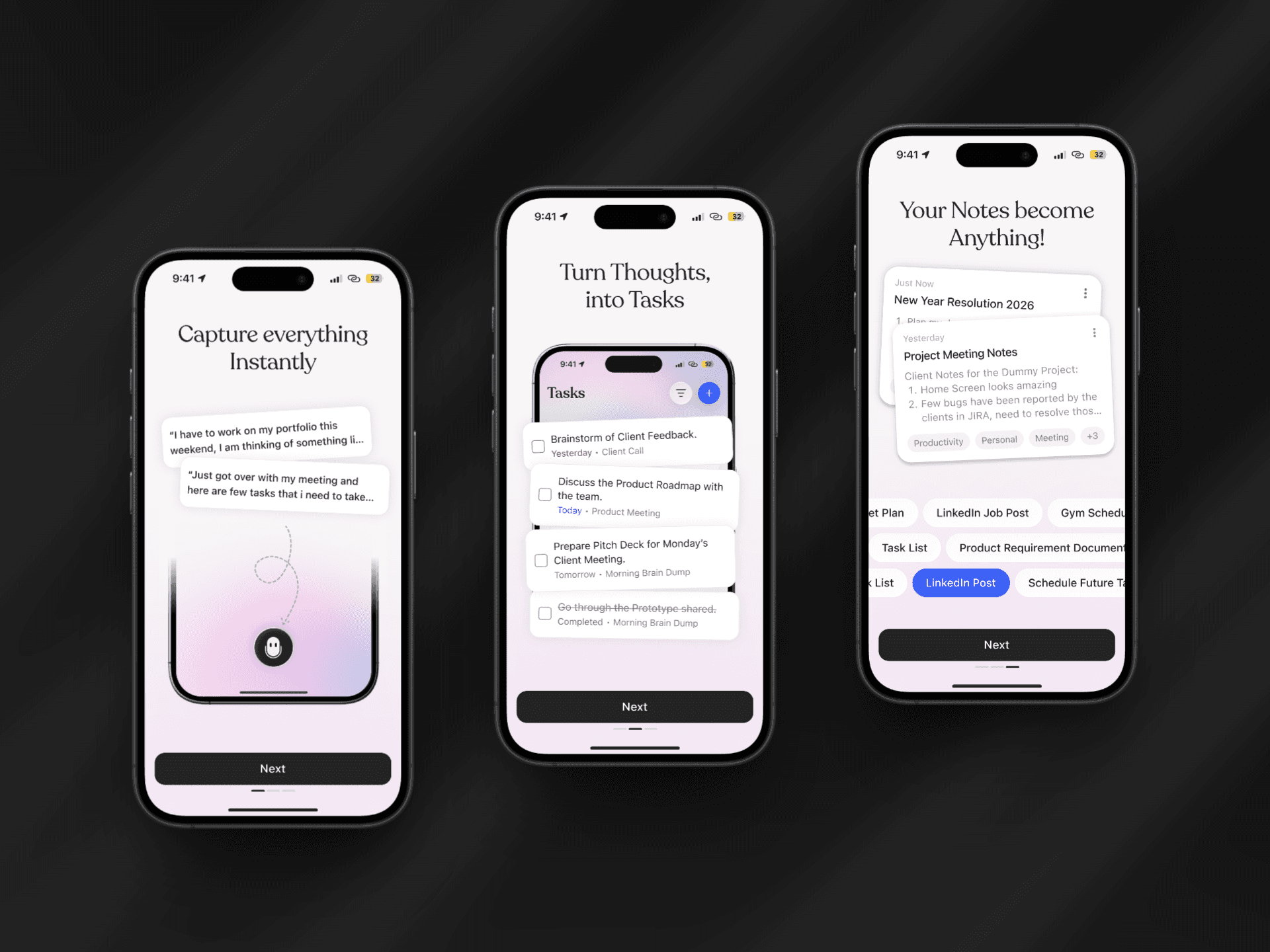
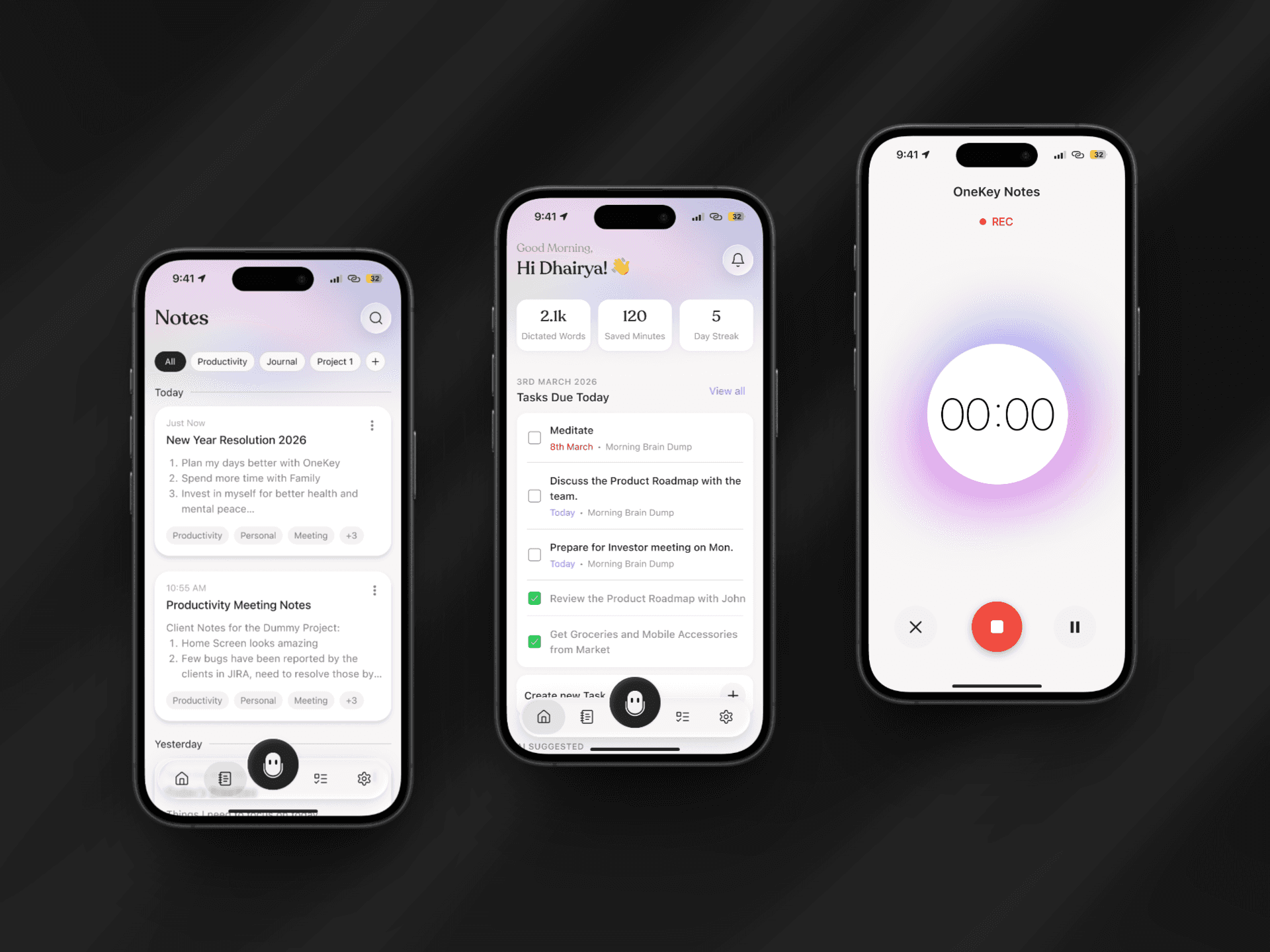
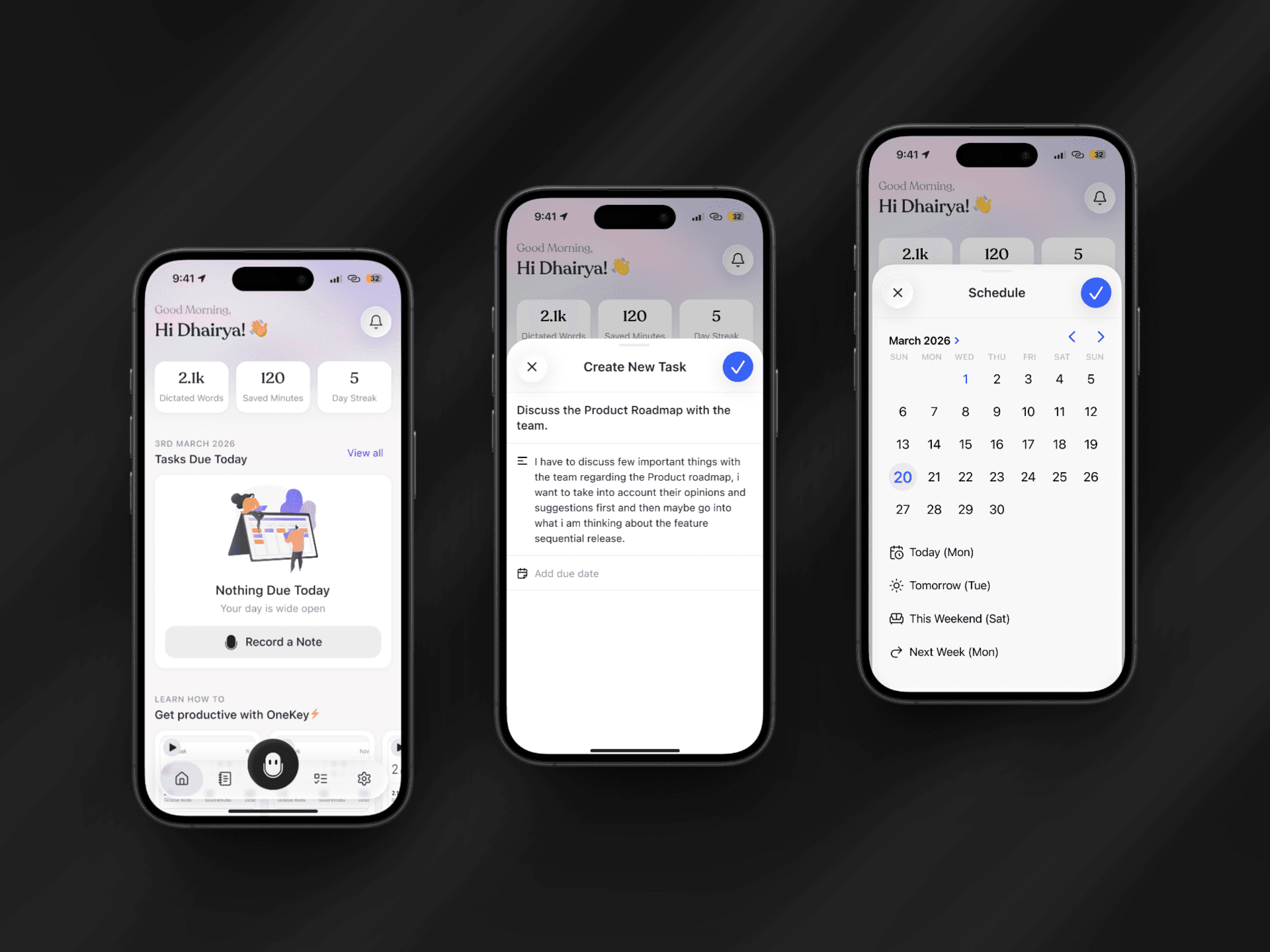
SELECTED SCREENS
Next case
First direct client engagement. 2-month sprint with the CEO, shipped end-to-end.